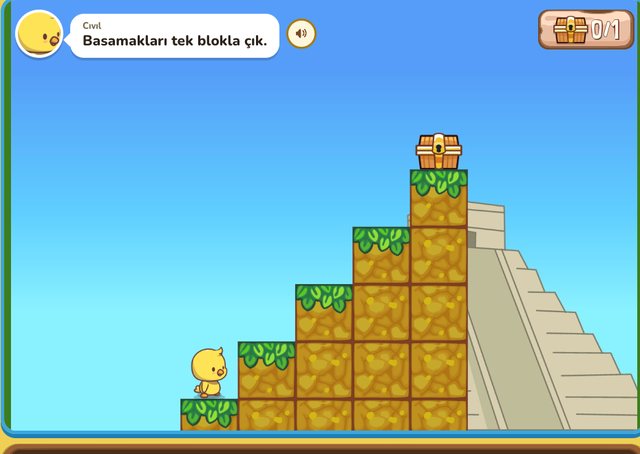
First blocks
Sequencing with wordless picture blocks, counting steps, and a first loop.
Renkli DuvarlarSee the towerA child arranges the blocks in order, presses Run, and the hero sets off. Kodla Zıpla starts with picture blocks in kindergarten, then climbs tower by tower through loops, conditions, and data, all the way to Python.
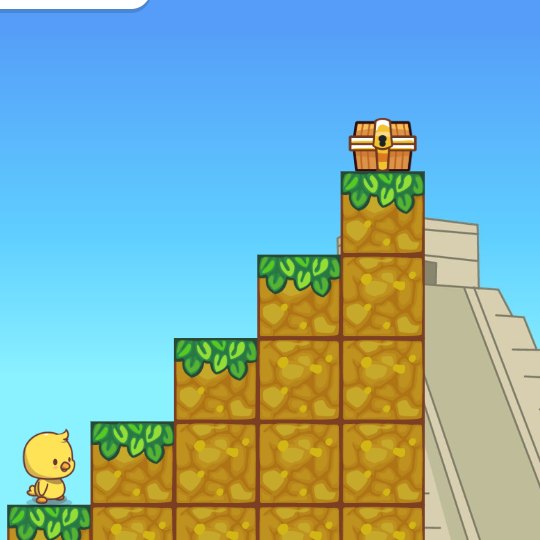
Wordless picture blocks in kindergarten, blocks with words in elementary school, pseudocode and Python in middle school. The same heroes, the same towers.
When a program breaks, the game says what happened: "Lale bumped into the wall." The child looks at the block, fixes it, and tries again.
Three stars: finish the task, finish it on the first try without looking at the solution, and write the shortest program.
In the kindergarten tower, the blocks are wordless pictures; children build a program by tapping. Audio narration for the tasks is being prepared.
Five medium-difficulty levels from the real game. Play in your browser; your progress stays only on this device.
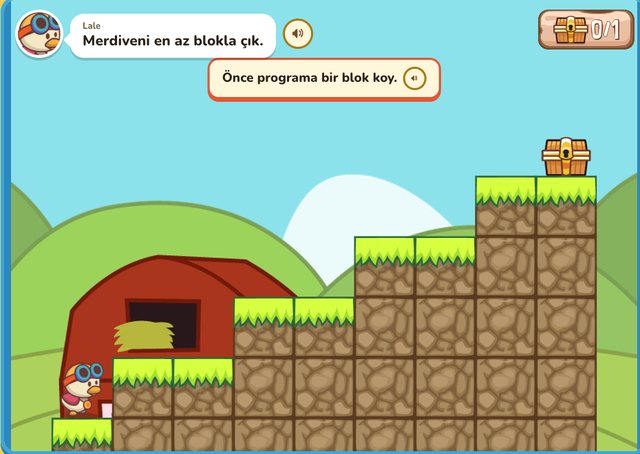
Add blocks from the tray at the bottom to your program, then press Run (Çalıştır). The game is in Turkish.
Open full screen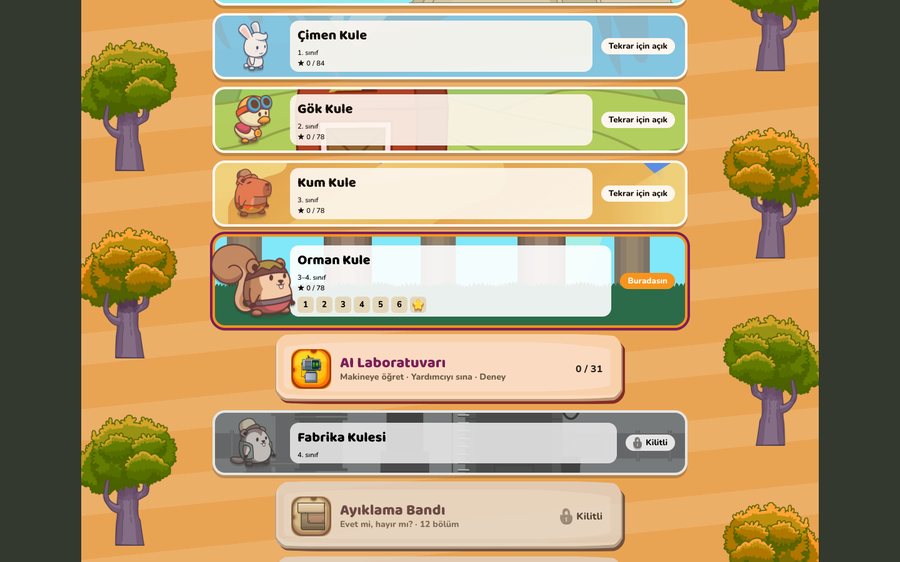
The tower path unlocks grade by grade. On each tower's floors, children work on sequencing, loops, conditions, data, breaking problems into parts, and debugging; at the summit, it all comes together. A child who gets stuck drops down to the same floor of the tower below, then comes back up.
Children start at the tower for their grade. Lower towers stay open for review; higher ones unlock once the summit is complete.
Sequencing with wordless picture blocks, counting steps, and a first loop.
Renkli DuvarlarSee the towerTurn, Repeat, and If with pictures; spotting the part that repeats to shorten the program.
Çimen Kule · Gök KuleSee the tower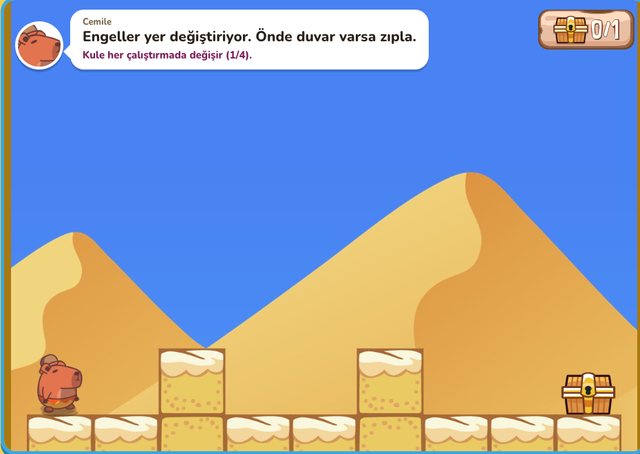
If/else, "until" loops, sensors; a program that works even when the tower changes on every run.
Kum · Orman · FabrikaSee the tower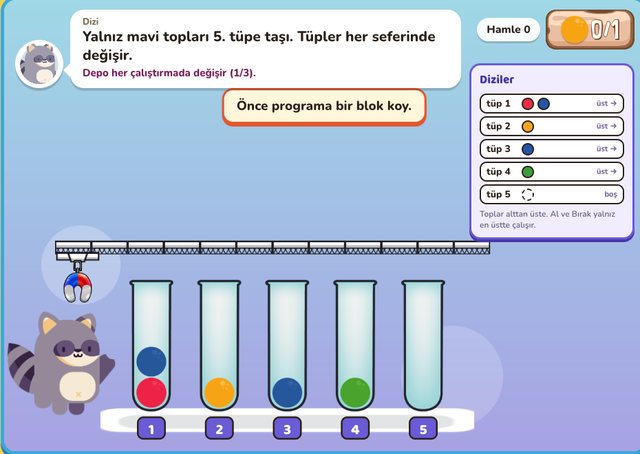
AND/OR, variables, arrays, functions with parameters; then the same towers in pseudocode and Python.
Renk Atölyesi → Robot Atölyesi · Code TowersSee the towerThe lesson structure from the teacher's guide. Transitions get shorter as children learn the routine; the first two lessons are unplugged.
Experiencing the concept through movement or cards: Human Robot, the chair game.
Watching a faulty program together: "Where did this program take us?"
The new block's name and an everyday example.
Pair work: one child writes, the other watches; they switch roles at every level.
Counting the loop's repetitions and an exit ticket: "How many times did the loop go around?"
Kodla Zıpla is designed to be played in class with a teacher. Lessons away from the computer are part of the plan, too.
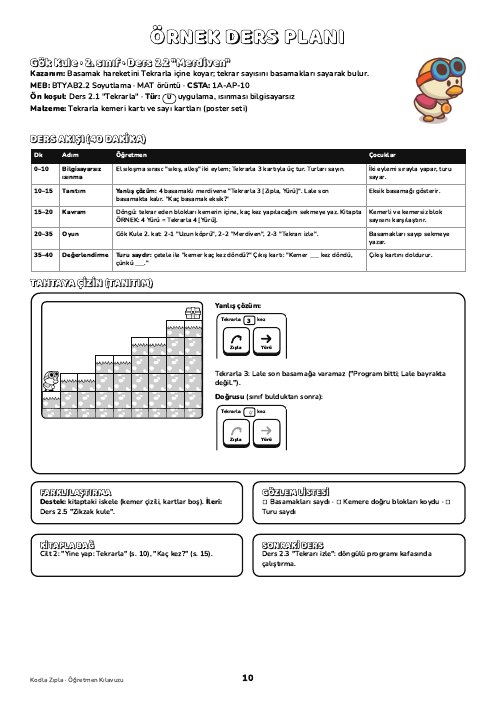
Scope and sequence, 40-minute lesson plans, and floor-by-floor teacher notes.
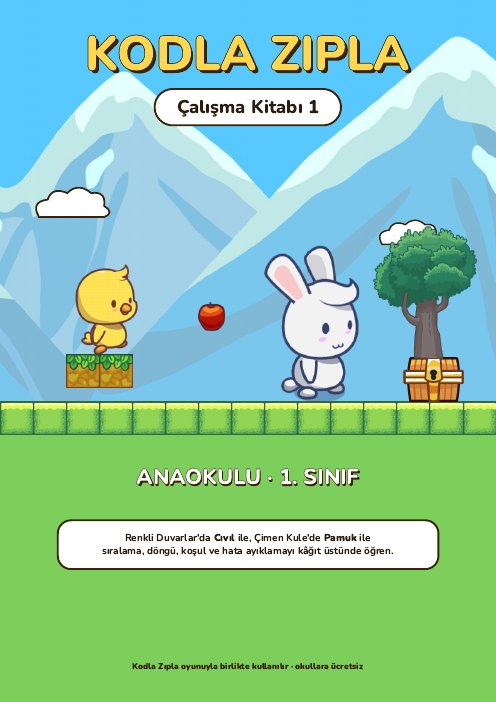
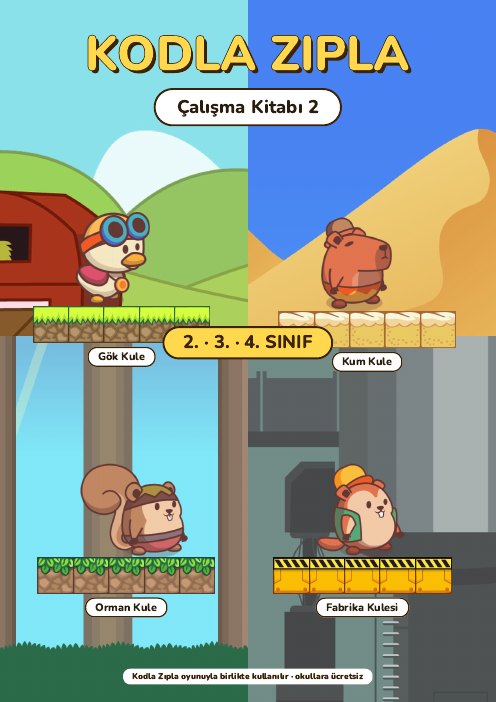
Two volumes: a paper page for every floor of the game, plus cut-and-play block cards.
The first two lessons for every tower use movement and cards: Human Robot, the programmer on the grid.
The guide lists each lesson's learning outcome and the matching codes from Türkiye's Maarif curriculum and the CSTA standards.
The game doesn't say "Good job"; it describes what the child did: "You finished with 3 blocks."
The game does not ask children for an address, phone number, or photo, and the AI section does not use a camera or microphone.
The child shows example cards to a gatekeeper, and the gatekeeper learns to make decisions from the examples. Children see how it makes mistakes when it has too few examples, and how it becomes biased when it is always shown the same kind of example. The lab has 31 tasks: Teach the Machine, Test the Helper, and the Experiment Floor.
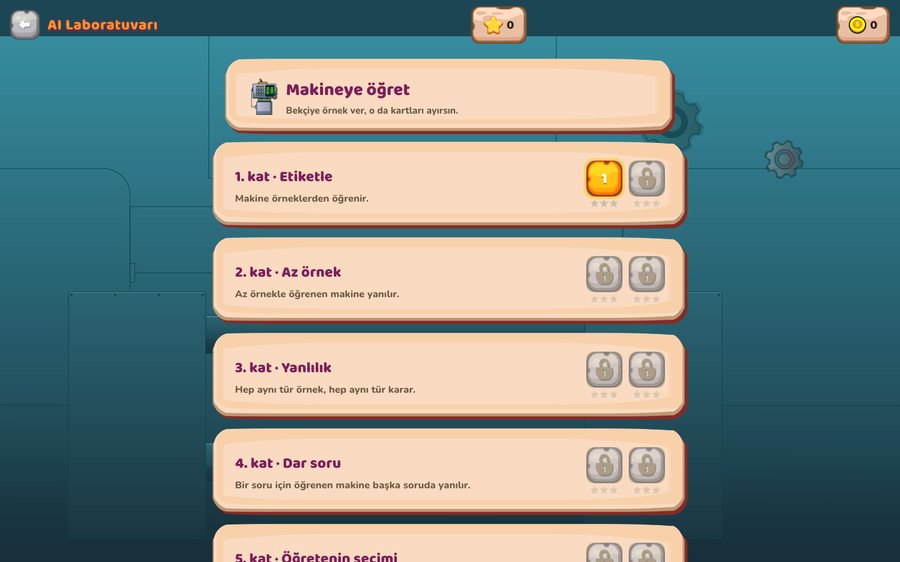
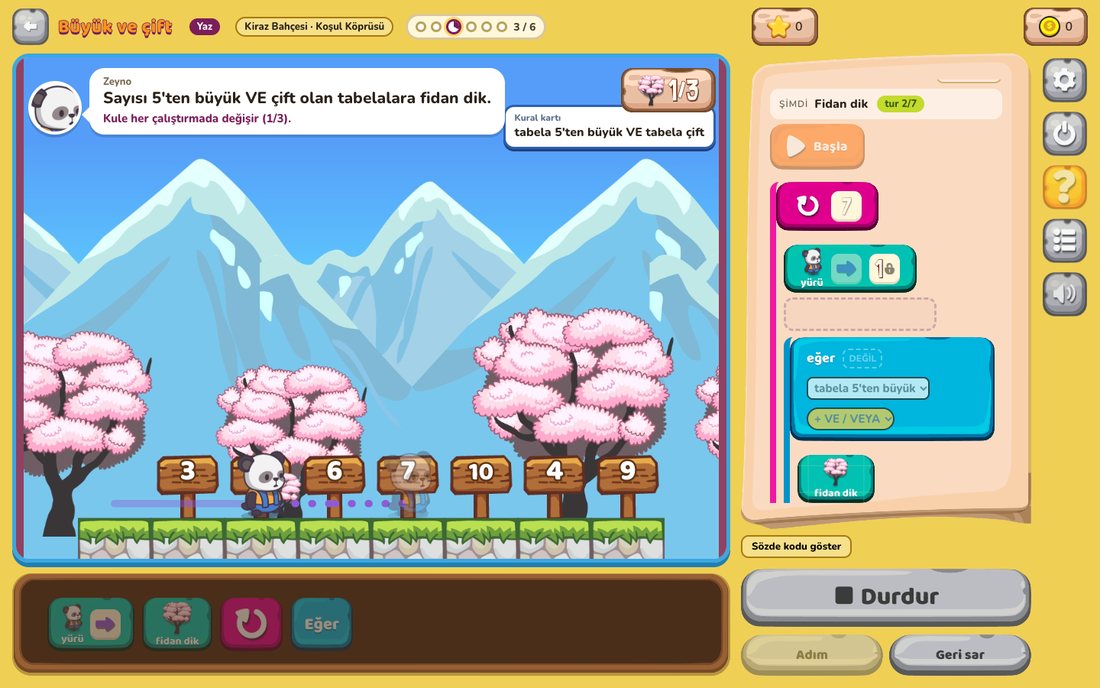
Doors along the tower path lead to text-based coding, artificial intelligence, making your own game, and short computing modules.
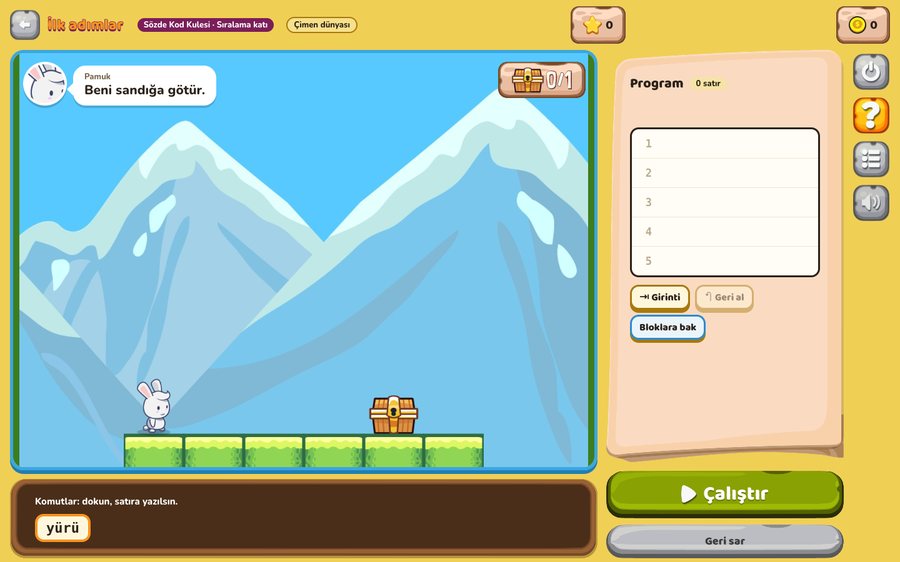
The same levels, first in Turkish pseudocode, then in Python: 3 towers, 105 levels.
A gatekeeper that learns from examples, a helper that works with request cards, plus prediction and experiments.
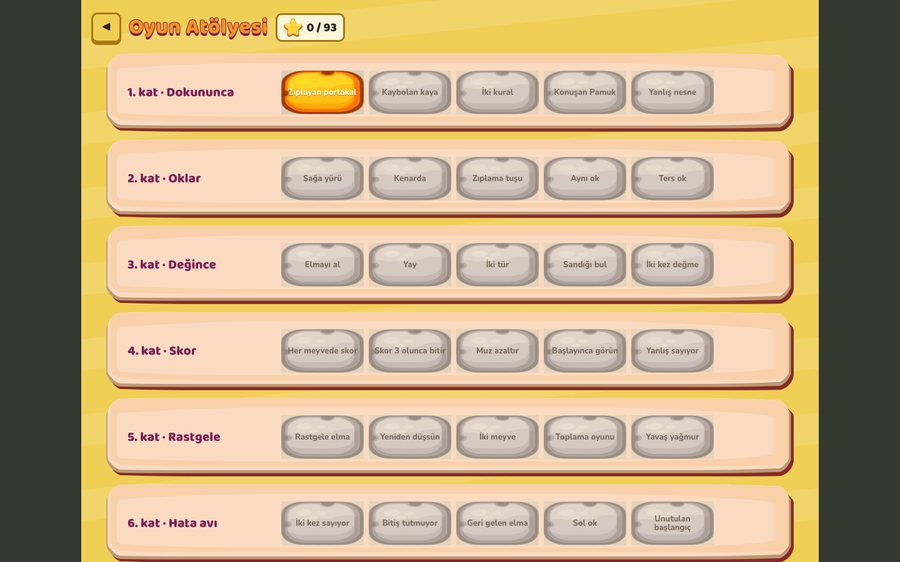
Build your own small game with events, keep score, and share your code with a friend.
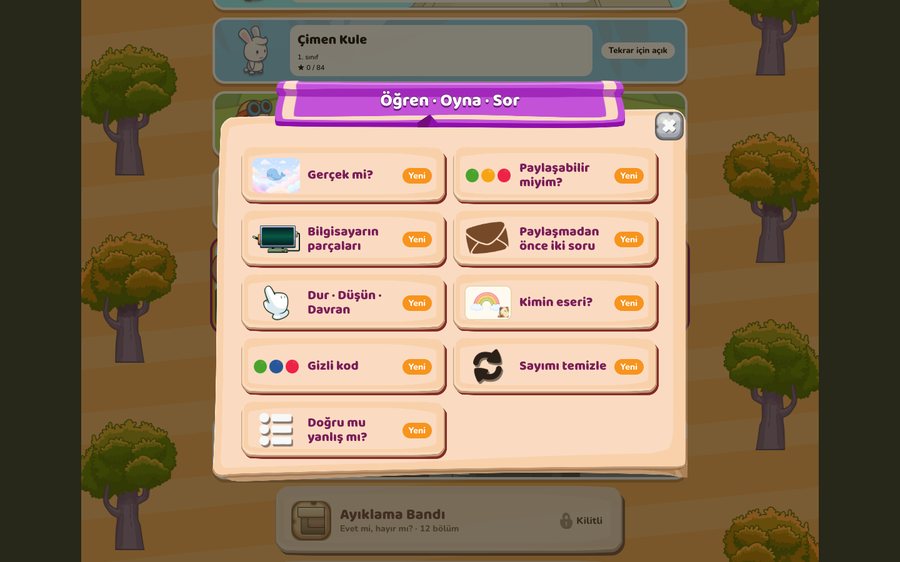
Nine short modules, including "Can I share this?", "Is it real?", and the parts of a computer.
Eleven heroes, eleven towers. In each tower, the child guides a different hero to the treasure chest.

Repeats with a loop and looks at the tower to choose the right block.

Climbs the stairs with Repeat and checks what's ahead before jumping.

Uses If/else to get past a tower that changes every time.

Walks until reaching the wall; a condition says when to stop.
"You finished with 4 blocks. The shortest solution is 3 blocks."
When a level ends, the game states the result in numbers. The child looks for a shorter way.
"Cemile bumped into the wall."
The error message describes what happened. The teacher asks: "Which block did that?"
"The program didn't finish in 300 steps; the loop may never stop."
When a loop doesn't stop, the Stop button flashes; the child checks the condition.
Printed materials to use alongside the game. All in Turkish, A4 size.
The questions schools and parents ask most often. If you don't find your answer here, write to us.
The game and the printed materials are in Turkish for now. This website is available in four languages.
Kindergarten to grade 8. From kindergarten to grade 6, eleven block towers unlock grade by grade; in grades 6–8, three Code Towers continue with pseudocode and Python.
It runs in a web browser on computers and tablets. Keyboard Bridge lessons require a keyboard.
In the kindergarten tower, the blocks are wordless pictures. Audio recordings that read the tasks aloud are being prepared.
Yes. The first two lessons for every tower are unplugged; the instructions are in the teacher's guide, and the children's pages are in the workbook.
The game does not ask children for an address, phone number, or photo. The AI section does not use a camera or microphone.
Request a trial for your school. We'll send your teachers a login code so they can try the game in their own classes. Then we'll plan together which class starts with which tower.
One class, forty minutes. The children write their first programs, and you see how the game works in a real classroom.